
If you own a Dachshund, French Bulldog, or another dog predisposed to back problems, you’ve probably heard the letters IVDD.
Maybe you’ve even been warned:
Don’t let them jump. Don’t let them use the stairs. Don’t let them do anything that might hurt their back.
Which sounds reasonable.
Except for one small problem.
They’re dogs.
They run. They play. They jump onto furniture they’re absolutely not supposed to be on. They launch themselves off things for reasons known only to them.
We can reduce unnecessary risks. But we can’t roll them in cotton and pretend they aren’t mobile creatures who enjoy using their bodies.
So, what can we do?
To answer that, we first need to understand what IVDD actually is… and then I want to talk about something much more interesting to me: whether integrative medicine may give us another way to think about protecting their vulnerable spines.
First: What Exactly Is IVDD?
IVDD stands for intervertebral disc disease.
Think of your dog’s spine as a long row of individual bones called vertebrae. Between most of those bones sits an intervertebral disc that acts as a cushion.
I like to describe each disc as a rubbery ring with a gel-like center.
When everything is healthy, that rubbery outer ring contains the softer material inside. The disc provides cushioning and allows the spine to move.
With IVDD, the disc degenerates. In the type we commonly see in breeds such as Dachshunds and French Bulldogs, the outer ring can crack or tear, allowing material from the center to extrude into the spinal canal.
And that’s where the real problem begins.

How IVDD happens
Why Can a Tiny Disc Cause Such a Big Problem?
Inside the spinal canal is the spinal cord.
Think of the spinal cord as the body’s communication highway. Messages constantly travel between the brain and the rest of the body, carrying information necessary for movement, pain, sensation, and awareness of where the limbs are in space.
Here’s the problem:
There is essentially no extra room in the spinal canal.
The spinal cord is surrounded and protected by the vertebrae, but this isn’t a roomy little tunnel with some extra space available in case something else wants to move in.
Not even Ant-Man would fit.
So, when disc material ruptures into the spinal canal, it doesn’t politely settle into some unused corner. There isn’t one.
It takes up space that the spinal cord needs.
That creates compression of the spinal cord… and the force of the extrusion itself can also injure it.
How much trouble that causes depends on where the disc ruptures, how much material extrudes, how quickly it happens, and how severely the spinal cord is affected.
One dog may simply hurt.
Another may become a little wobbly.
Another may suddenly be unable to walk.
Neurologic signs can progress from:
Pain → proprioceptive deficits → ataxia and weakness → inability to walk → paralysis
And in the most severely affected dogs, conscious perception of deep pain can eventually be lost.
Where the Disc Ruptures Matters
A disc problem in the neck can look very different from one farther down the spine.
Dogs with cervical IVDD may have obvious neck pain, but sometimes the signs are surprisingly subtle, or the pain may seem to come from somewhere else. They may hold their head stiffly, avoid lowering it to eat, stop jumping, or even limp on a front leg.
That front-leg pain is called a nerve root signature. A nerve leaving the spinal cord becomes irritated or compressed, making the leg appear painful even though the problem is actually in the neck.
If cervical spinal cord compression becomes severe, neurologic problems can affect all four legs.
A rupture farther down the spine, particularly in the thoracolumbar region, generally affects the hind limbs. Dogs may become wobbly or weak, cross their feet, knuckle their paws, or eventually lose the ability to walk.
In short: where the disc ruptures helps determine where we see the symptoms.
What Is “Deep Pain,” and Why Does It Matter?
This is something that’s easy to misunderstand.
If I pinch a dog’s toe and the leg pulls away, that doesn’t necessarily mean the dog consciously felt what I did.
That can be a spinal withdrawal reflex. The signal travels into the spinal cord and immediately back out to the leg without ever needing to reach the brain.
In a severely paralyzed dog, we need to know whether the brain can still consciously perceive a painful stimulus.
We’re looking for a deliberate response…turning toward us, vocalizing, trying to bite… not simply pulling the leg away.
Loss of deep pain perception tells us that the spinal cord injury is extremely severe and makes the prognosis considerably more guarded.
That’s also why a dog who suddenly loses the ability to walk is not a “let’s see how he feels tomorrow” situation.
How Is IVDD Treated?
Treatment depends on severity.
A mildly affected dog who can still walk may be treated with strict exercise restriction, pain control, anti-inflammatory medications and sometimes muscle relaxants. And when I say exercise restriction, I mean it—a dog feeling better does not mean the disc has healed.
For dogs with significant neurologic deficits, particularly those who can no longer walk, surgery to remove the extruded disc material and relieve pressure on the spinal cord may offer the best chance for recovery.
But surgery isn’t the only option.
Some dogs can regain function with conservative treatment, and studies have shown that acupuncture and electroacupuncture can improve motor recovery in dogs with IVDD, especially when combined with conventional medical treatment.
That’s important because spinal surgery isn’t financially possible for every family. If surgery isn’t an option, that doesn’t mean there is nothing we can do. Depending on the severity of the injury, medical management, strict rest, nursing care, rehabilitation and acupuncture may still offer a path to recovery.
The more severe the spinal cord injury…particularly if deep pain perception has been lost… the more guarded the prognosis becomes.
There are also exciting new treatments being studied, including work at Texas A&M using an injectable enzyme to dissolve herniated disc material.
But here’s the question I find even more interesting:
What if we could do more before the disc ever ruptures?
Can We Prevent IVDD?
Western medicine gives us some very sensible recommendations.
Maintain a healthy weight. Use a harness rather than putting unnecessary pressure on the neck. Reduce extreme jumps when practical. Provide steps, ramps or lower surfaces so your 15-pound dog doesn’t repeatedly attempt an Olympic long jump onto your bed.
For dogs prone to cervical problems, I like elevated food and water bowls, so they don’t have to repeatedly bend their neck all the way to the floor.
I also don’t recommend tug-of-war games where a human is pulling on the opposite end of the toy in a dog predisposed to cervical disease. If your Frenchie wants to shake a stuffed animal around like a tiny lunatic, that’s one thing. Adding a human pulling against the other end adds forces I’d rather avoid.
But there’s currently no Western medication I can give a young Frenchie or Dachshund and say:
“Here. This will prevent IVDD.”
And that’s where integrative medicine becomes very interesting to me.
Looking at the Disc Through a Different Lens
Remember my rubber-ring analogy?
Think about what happens to rubber when it is repeatedly exposed to excessive heat and loses moisture.
It becomes less supple.
Less elastic.
More brittle.
And eventually, it’s more likely to crack.
Traditional Chinese Veterinary Medicine looks at the body through concepts that include Heat, Yin, body fluids and balance.
The goal isn’t simply to treat a disease after it appears. Part of the philosophy is identifying imbalance and trying to restore a healthier internal environment before that imbalance creates… or contributes to…. disease.
We can use food therapy, Chinese herbal medicine and acupuncture to help bring an individual dog’s body toward a more balanced, thermoneutral state with appropriate nourishment and moisture.
And that brings me right back to our rubber disc.
If the tenets of TCVM are correct, then perhaps we’re also helping that “rubber” remain as supple and elastic as possible.
And perhaps a healthier, more resilient disc is less likely to fail.
Could that mean we might actually reduce the likelihood of a future disc extrusion in a genetically predisposed dog?
Maybe.
And I find that possibility fascinating.
But this is where I need to draw a very clear line between theory and proof.
We do not currently have scientific evidence demonstrating that TCVM prevents IVDD.
I cannot tell a Frenchie owner, “Feed this food, give these herbs and do acupuncture, and your dog won’t rupture a disc.”
I wish I could.
What I can do is look at a dog who is genetically or structurally predisposed to IVDD and ask:
How can I give this particular body the healthiest environment I reasonably can?
And I can do that while also using everything Western medicine has to offer.
Which brings me to Birdie.

Meet Birdie
Meet Birdie
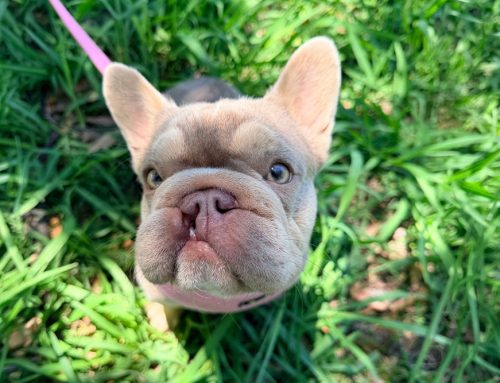
Birdie is my French Bulldog.
She’s opinionated. She’s judgmental. And she loves her family with the strength of old Gorilla Glue.
It may stick forever.
It may crumble at any point.
And this is Birdie’s spine.

Birdie’s spine

A more typical canine spine
For comparison, this is what a more typical canine spine looks like.
Birdie has significant congenital vertebral malformations and severe curvature of her spine.
It’s not exactly the radiograph a veterinarian looks at and thinks:
“Well, that’s reassuring.”
Does it mean Birdie is destined to become paralyzed someday?
I don’t think so.
But it absolutely influences how I care for her.
What Do I Do for Birdie?
I work hard to keep Birdie’s body as balanced as I can.
Her diet isn’t chosen simply because the bag says “French Bulldog.”
Her food and TCVM plan are individualized for Birdie… her age, personality, constitution, tendencies, medical issues and even the climate in which she lives.
I use food therapy.
I use Chinese herbal medicine.
I use acupuncture.
I keep her at a healthy weight.
And I still let her be a dog.

Opinionated. Judgmental. Birdie.
Has that prevented Birdie from ever having IVDD symptoms?
No.
She’s had three episodes of cervical pain.
But here’s where knowing your own dog becomes incredibly important.
Birdie Doesn’t Say “My Neck Hurts”
Birdie didn’t cry.
She didn’t dramatically collapse.
She stopped eating.
That might seem like a strange symptom of neck pain until you think about the mechanics.
Imagine your neck really hurts.
Now bend your head toward the floor every time you want to take a bite of food.
Even with an elevated bowl, Birdie decided eating wasn’t worth it.
The other enormous clue?

Couch Potato
She stopped jumping onto the couch.
This is Birdie we’re talking about.
Birdie is a couch potato of the highest order. She appears to believe it is her sole responsibility to prevent our couch from floating off into space.
She takes her job very, very seriously.
So, when Birdie doesn’t want to jump onto the couch, I pay attention.
Another sign I frequently see with cervical IVDD is front-leg lameness from the nerve-root pain I mentioned earlier. Birdie hasn’t shown that particular sign, but I’ve seen it often in other patients.
That’s one of the most important lessons I want pet owners to understand:
Pain doesn’t always look like pain.
Sometimes it’s simply a dog who suddenly stops doing something they’ve always done.
How Did I Treat Birdie’s Flare-Ups?
I treated her integratively.
Not Western medicine or Chinese medicine.
Both.
She received appropriate anti-inflammatory medication and pain control along with exercise restriction. Which she took very personally.
I also treated her with acupuncture and Chinese herbal medicine selected specifically for her TCVM pattern.

Birdie receiving acupuncture
Within about three days, she was dramatically more comfortable and returned to her usual activities, including, thankfully, resuming her critical couch-stabilization duties.
Does that mean every dog with IVDD should receive exactly what Birdie received?
Absolutely not.
A mildly painful dog who is walking normally is an entirely different patient from a dog who woke up unable to move his hind legs.
Severity matters.
Location matters.
Neurologic status matters.
The individual dog matters.
And sometimes surgery is absolutely the right answer.
So, Can Integrative Medicine Prevent IVDD?
Here’s my answer:
I don’t know.
And I think that’s an important answer.
We know certain dogs are genetically predisposed to disc degeneration. We know some dogs are born with spinal anatomy that isn’t doing them any favors.
We also know that TCVM has a fundamentally different way of thinking about maintaining health and balance before disease becomes catastrophic.
If those principles are correct, then maintaining the healthiest, most resilient internal environment possible may help a vulnerable disc remain healthier, more resilient, and more elastic.
I hope someday we’ll have the research to tell us whether that’s true.
Right now, we don’t.
So I’m not going to promise something I can’t prove.
What I can tell you is what I do with my own dog.
I know the spine Birdie was born with.
I reduce the risks I can reasonably reduce.
I pay attention to tiny changes in her behavior.
I use Western medicine when she needs it.
I use nutrition, acupuncture and Chinese herbal medicine to support her as an individual.
And when something changes, I intervene early.
Can I prove that doing all of that will keep Birdie from ever having a catastrophic disc rupture?
No.
Could supporting her body throughout her life help reduce that risk?
Maybe.
And with a spine like Birdie’s, maybe is enough reason for me to keep asking the question.
Then I let Birdie be Birdie.
Because protecting her spine matters.
But so does letting her live her life.

Let Birdie be Birdie.


Leave A Comment